


Accountable
Measurable
Achievable
ESG Strategy
To place ESG sustainability at the centre of our working practices, we have developed a long-term programme that helps both Pearce Signs and our customers work towards measurable environmental and corporate sustainability objectives.
Our ESG strategies are based on clear targets, regular evaluation and transparent reporting. There is no final finishing line: corporate responsibility and sustainability require continued improvement, honest measurement and accountability for the decisions we make.
Discover how NatWest Group’s corporate sustainability objectives shaped its UK signage rollout.
Our ESG Objectives and Progress
Our sustainability goals for 2025. A short, sharp focus on some key big wins.
ESG Strategies for Sustainable Signage
Our ESG strategies influence how we design, engineer, manufacture and implement signage. Through responsible material selection, value engineering, efficient illumination and product lifecycle planning, we help customers explore more sustainable solutions without compromising brand consistency, quality or performance.
Discover how our collaborative approach has supported measurable sustainability objectives across customer signage programmes.

NatWest Group
When UK banking brand NatWest Group set themselves ambitious sustainability objectives for its UK company sign roll-out, we worked with them to look at everything from…
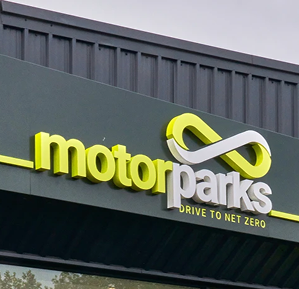
Motorparks
Motorparks is seriously committed to sustainability through its ‘Drive to Net Zero’ agenda, and here we helped with a value engineering exercise during a tight time frame.
ESG Compliance and Reporting
Our approach to ESG compliance brings together applicable environmental legislation, recognised reporting frameworks, customer requirements and internal governance controls.
We review our performance regularly and use measurable information to guide decisions around energy, materials, waste, procurement, working practices and the sustainable signage solutions we develop for customers.
This also includes how we devise and present sustainable signage solutions for our clients. One of the key external frameworks is the environmental measures referred to as Scope 1, Scope 2 and Scope 3 emissions. Here’s a quick overview.
These are direct greenhouse (GHG) emissions that occur from sources controlled or owned by us. For instance, the energy we use in company vehicles getting out and about on business. Provided we set clear targets and objectives, this is probably the easiest set of emissions for us to monitor and track.
Scope 2 emissions focus on indirect GHG emissions that occur through the purchase of gas and electricity that are beyond our direct control. In other words, the energy use that is created from external sources. This is where we measure the impact of our heating, ventilation, air conditioning and lighting systems.
Also known as “value chain” emissions, Scope 3 focuses on the impacts of activities from assets not owned or controlled by us but which affect what is happening up and down our supply chain. So this is about what our suppliers, material producers and sub contractors do, and their impact on the environment.

UN Development Goals
As a global business, we’ve always adopted a global mindset to everything we do. Not least of all with sustainability. Therefore it was imperative that we signed up to the United Nations 17 Development Goals of Sustainable Development which form a global call of action to work towards as part of the 2030 Agenda for Sustainable Development.
As a recent signatory to this programme, we’ve aligned our thoughts and values to those goals which best reflect our key areas of work and where we know we can make a real, continuous impact.
 Good Health and Well-being
 Affordable and Clean Energy
 Decent Work and Economic Growth
 Industry, Innovation, and Infrastructure
 Reduced Inequalities
 Responsible Consumption and Production
 Climate Action

Carbon Disclosure Project
Set up in London in 2000, the CDP is a not-for-profit organisation that aims to achieve full transparency in the way companies report on the impact their commercial activities have on the environment. The Carbon Disclosure Project (CDP) is therefore a really important global platform that enables us to submit data on the environmental impact of our activities.
This requires us to complete a significant and detailed questionnaire every year which covers our carbon emissions, plastics and materials use and the impact of any activities which might affect deforestation and even water security.

Net Zero
We don’t see Net Zero as an end goal in itself. Our approach to Net Zero is that we see it as part of a much wider series of collective political and environment goals, many of which are constantly moving as the regulations around them change.
Our primary objective is to be accountable for a series of much smaller, but equally significant goals.

Greenwashing
Accountable. Measurable. Achievable. Our sustainability campaign is called this because we want to prove that we are doing what we say.
Greenwashing often occurs when a company decides it doesn’t want to address the impact of its commercial activities – because it’s a difficult conversation.
No business can genuinely claim to be 100% sustainable. But we believe that we can put 100% effort into being as sustainable as we can, so that we can talk honestly about our achievements.

Greenhushing
Saying nothing is not an option. Achieving our sustainability goals is both time consuming and, in many cases, adds extra costs to a business.
As a business that makes things, we want to be entirely transparent about our environmental impact. And whilst we know we can’t be entirely green, we can show that we are being accountable by measuring what we do.
Let’s Talk Sustainability
Discuss how we can help you achieve your environmental objectives.